Share
Security Research
Quantifying Contagion Risk in Real-Time
September 10, 2026
•
Onchain finance is deeply interconnected. Composability is one of DeFi’s differentiators, but it also makes risk much harder to understand and quantify. When an asset fails, knowing who holds it directly is not enough. Risk teams need to understand every path through which that failure can propagate and, ultimately, calculate how much each participant could lose.
Mapping how a failure propagates
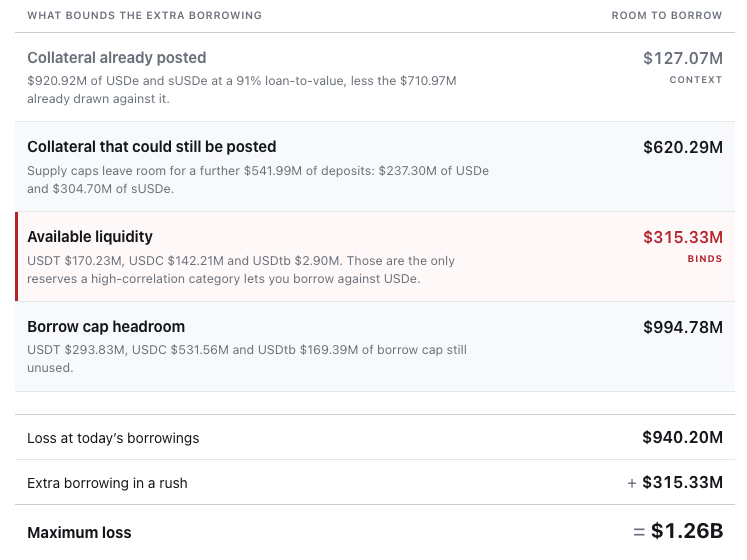
A Forta Risk analysis of USDe exposure in Aave v3 on Ethereum shows why. We model a severe, theoretical scenario in which USDe becomes worthless. On September 9, the estimated loss to Aave v3 would be approximately $940.20M, or 3.82% of assets. In a rush scenario, where borrowers extract the remaining liquidity available to them, losses could reach $1.26 billion, or 5.10%.
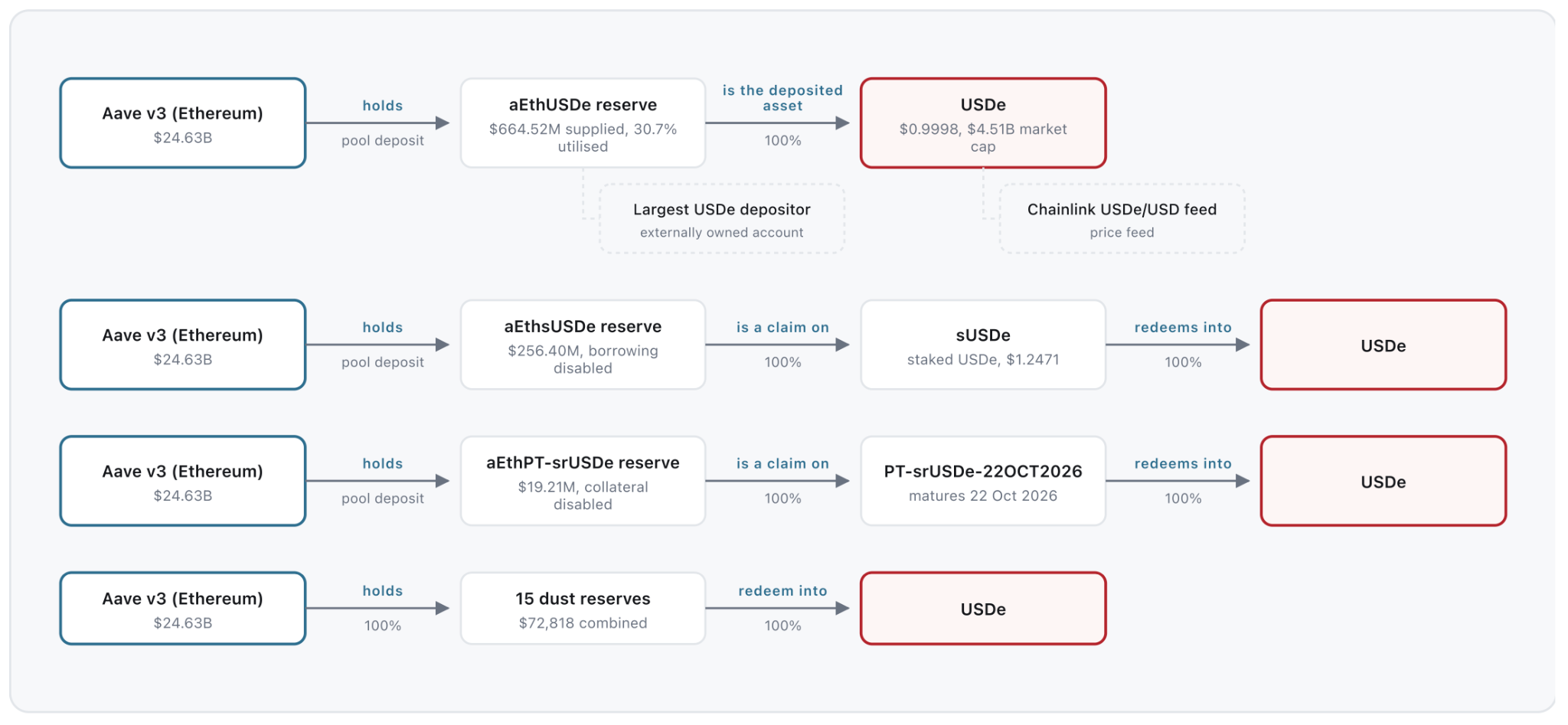
The interesting part is not only the size of the loss, but how it gets there. Some exposure is direct through Aave’s USDe reserve, while other paths run through assets such as sUSDe and Pendle principal tokens that ultimately redeem into USDe. And the exposure is not static. If an asset starts failing while its oracle still reflects the old price, holders may have an incentive to post it as collateral, borrow good assets and abandon the position. In the scenario analyzed, another $315.33 million could leave the market before liquidity itself becomes the binding constraint, increasing the modeled loss from $940 million to $1.26 billion
The loss doesn’t stay where the risk originated
The most important result appears when we stop looking at Aave as one large pool and ask who actually loses the money.
Consider a plain USDT depositor. USDT is the deepest stablecoin market in the protocol, with $2.97 billion supplied at the time of the analysis. This user has no leverage and no USDe anywhere in their position.
Yet if USDe were compromised, USDT suppliers would face an estimated loss of 16.7% of their supplied assets, rising to 22.4% if the reserve's remaining liquidity were drained entirely. The loss reaches them because other accounts borrowed USDT against USDe-linked collateral. When that collateral becomes worthless and those borrowers abandon their positions, the bad debt is left with USDT suppliers.
Aave's Umbrella safety module is designed to absorb exactly this kind of shortfall, acting as a junior tranche that takes losses before depositors do. But the USDT Umbrella module currently holds only around $71 million, so plain vanilla USDT depositors would still face losses of 14-20%.
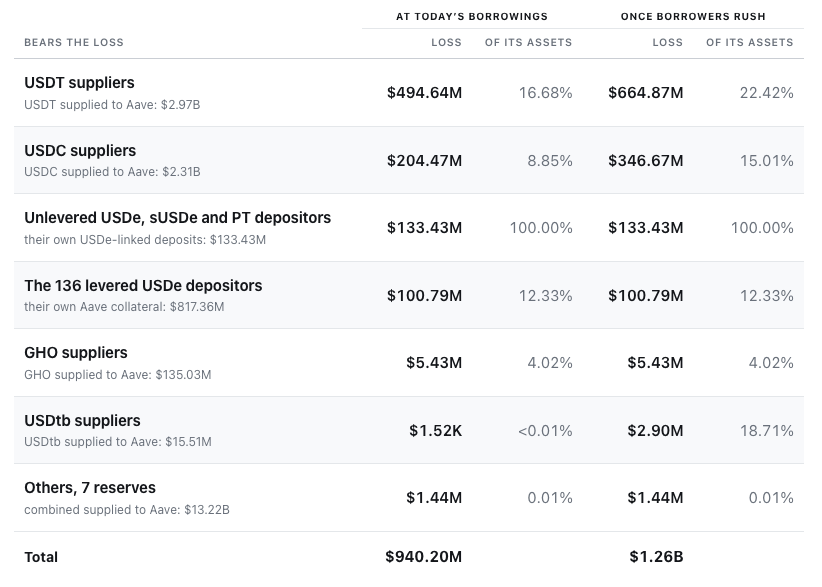
This is why protocol-level risk tells only part of the story. The same failure can affect each depositor, vault or institution very differently depending on how their capital is connected to the rest of the system.
For a vault curator, the relevant question is how much a particular vault could lose. For an asset manager, it is which positions are economically exposed to a failure even when the failing asset does not appear anywhere in the portfolio. For a protocol, it is how much bad debt can there be and where it will ultimately land.
A real-time system requires a real-time view of risk
This USDe scenario is a stress test analysis, not a prediction or an expected-loss calculation. The broader lesson is that understanding onchain risk requires more than knowing what assets you own. It requires a live view of the dependencies between assets and protocols, the paths through which failures can propagate, and the ability to quantify what those failures mean for each participant.
That is what Forta Risk is designed to make visible: not simply what you hold, but a real-time view of what you depend on, how a failure can reach you, and how much you could lose under different scenarios.
Your portfolio does not define the boundaries of your risk. Request a demo to explore how Forta Risk can provide a real-time view of your onchain exposure.
.png)
.png)